

Paying Cash for Your Costa Brava Home? Here's Why a Mortgage Might Save You Money
A quick note before we start: I'm a property search specialist, not a tax or financial adviser. This article shares general information based on the rules as they stand in 2026. Tax rules change and every buyer's situation is different, so please get individual advice from a qualified tax adviser and a mortgage broker before making any decisions. They can apply this to your own circumstances and tell you exactly where you stand.
Many of the buyers I work with plan to pay cash. It feels simpler, there's no bank to deal with, and after years of saving, owning your home outright is a lovely feeling. I completely understand it.
But if you're buying on the Costa Brava as a non-resident, paying cash isn't always the cheapest option. In certain cases, a mortgage can actually save you money due to a local wealth tax.
Reason one: a mortgage can reduce your wealth tax
Spain has an annual wealth tax ( Impuesto sobre el Patrimonio). If you're not tax resident here, it only applies to what you own in Spain, such as your house and any Spanish bank accounts.
For non-residents buying in Catalonia, the first €700,000 per person is generally tax-free under Spain's national rules. The key detail is that the tax is based on your net assets: the value of what you own, minus the debts attached to it. A mortgage secured on your Spanish home reduces that net value.
Here's a simple, illustrative example:
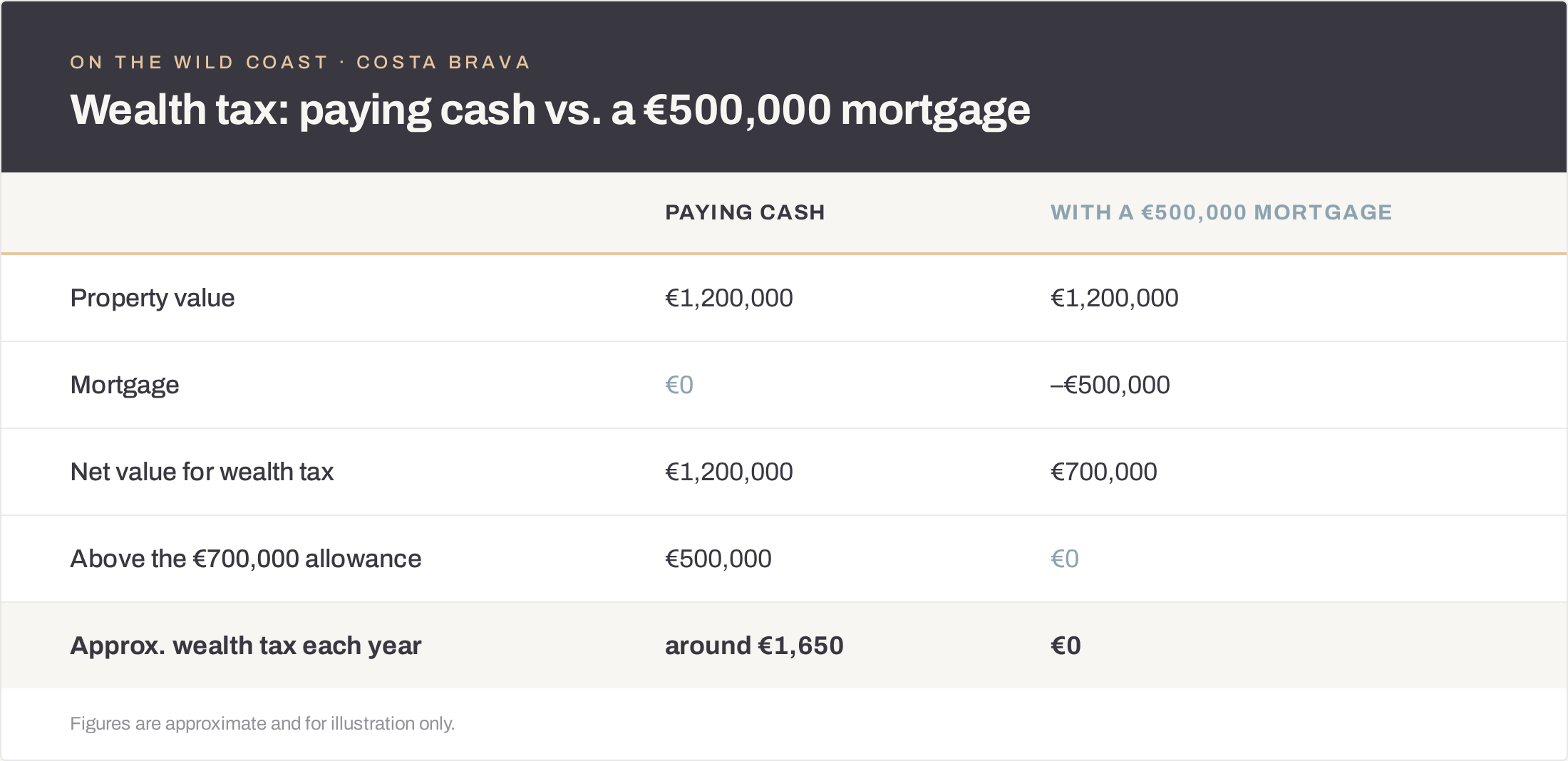
Comparison between paying with cash vs mortgage
That saving repeats every year the mortgage stays in place, although it shrinks as you pay the loan down.
Reason two: your savings can keep working for you
The wealth tax saving on its own rarely justifies a mortgage. Interest on €500,000 will most likely cost more than the wealth tax. The real question is what your cash would be doing instead.
If your savings or investments back home earn more after tax than the mortgage costs you, keeping them invested and borrowing for the house can leave you better off. The wealth tax saving then becomes a welcome bonus on top. If your cash would otherwise sit in a savings account earning very little, the maths may well point the other way.
Reason three: money in reserve
Buying a home in Spain rarely ends at completion. There's furniture, often some renovation, a pool that needs attention, and the unexpected surprises that come with older houses. Keeping some of your cash available rather than putting everything into the purchase gives you breathing room, especially in your first year.
What to do before you decide
The best time to think about this is before you make an offer, not after.
When I work with clients, I encourage them to speak to a tax adviser and a mortgage broker early, alongside their lawyer, so the purchase is set up in the way that works best for them from day one. If you'd like a recommendation, or you're starting to think about your search, get in touch.
Frequently asked questions
Does a mortgage reduce wealth tax in Spain? It can be, yes. A mortgage secured on your Spanish property is deducted from its value when working out your net assets for wealth tax.
Can non-residents get a mortgage in Spain? Yes. Spanish banks lend to non-residents, usually up to around 60–70% of the property's value, depending on your income and circumstances.
Is it worth taking a mortgage just to avoid wealth tax? Usually not on its own. It tends to make sense when your cash can earn more elsewhere, with the wealth tax saving as an added benefit.
What is the wealth tax allowance for non-residents in Catalonia? Generally €700,000 per person under Spain's national rules. Couples who co-own a property each have their own allowance.